
Engineered Next Door: A Custom SPANMASTER® System for FAST Global Solutions
This summer, TC/American designed and installed a custom overhead lifting system for a fellow Glenwood manufacturer — a project that shows what a century of lifting experience can do when it's pointed at one customer's exact needs.
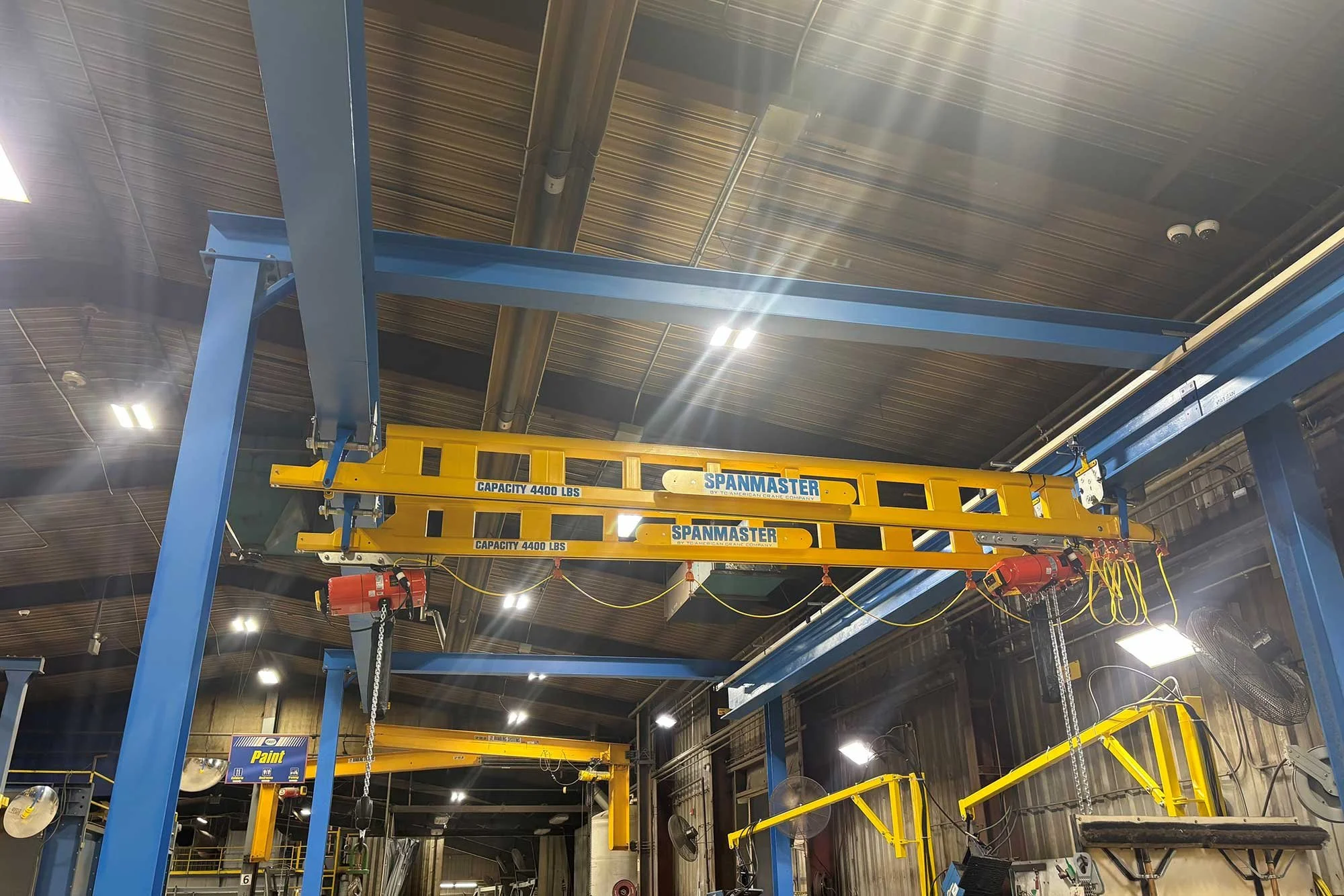
When FAST Global Solutions set out to upgrade the overhead lifting in one of its work areas, the right partner turned out to be right down the road. FAST and TC/American are both Glenwood, Minnesota manufacturers, and this past summer the two teams worked side by side to design, build, and install a SPANMASTER® overhead lifting system engineered specifically for FAST's operation.
The result is a system that didn't exist off a shelf. It was built around how FAST actually works.
Built around FAST's workflow
Rather than fitting FAST into a standard crane configuration, we started with their goals. FAST walked us through their workflow, their handling challenges, and the ergonomic realities their team lives with every day. From there, our engineers designed a system to match — one that reduces strain on operators and makes moving material feel intuitive instead of cumbersome.
Two SPANMASTER features made a real difference here.
Articulating end trucks. This proprietary SPANMASTER technology lets each bridge move freely and ergonomically, even at slight angles. For FAST's team, that translates directly into smoother handling and less operator fatigue.
No spreader or spacer bars required. Many crane systems limit how bridges can work together, restricting whether more than one bridge can pick up a given load. We engineered this system without that constraint, so multiple bridges can run bumper to bumper anywhere along the runway and lift together under full load. With 32-foot column spacing and a runway rated for three cranes, FAST gained real freedom to move product in and out of the area.
The full install was completed in just three days, with close coordination between both teams.
System at a glance
Configuration: SPANMASTER® overhead lifting system, custom-engineered
Bridges: Three custom-built 2-ton bridges
Span: 16-foot span on each bridge
Runway: 67-foot runway on six columns; 32-foot column spacing
Capacity: Runway rated to support three 4,400-lb-capacity cranes
Motion: Articulating end trucks (proprietary SPANMASTER technology) for smooth, ergonomic movement
Hoists: Electric chain hoists operated by wireless handheld radios
Installation: Completed in three days
"This was a system designed around exactly what FAST needed.
They told us what they were trying to accomplish, and we engineered the solution to fit."
A project close to home
There's something fitting about two Glenwood manufacturers building this together. Local partnerships like this one shorten lead times, keep the working relationship close, and keep manufacturing momentum in the community that both companies call home.
Credit is also due to Olsen Chain & Cable and their sales representative Mark Nolan, who has supported FAST for years with below-the-hook rigging. Mark connected FAST with our team early on and helped guide the initial measurement and quoting. After comparing options, Olsen recommended SPANMASTER for its pricing, its articulating bridges, and its ability to run multiple bridges in close proximity under full load — the same capabilities that ended up defining the finished system.
Custom lifting, engineered for the work
TC/American has been solving overhead lifting problems for more than a century, with roots going back to 1925 and a product line spanning patented track cranes, workstation cranes, monorails, box girder cranes, and fully custom-engineered systems. The FAST project is a straightforward example of how we work: understand the job first, then engineer the system the job actually calls for.
If your team is weighing a lifting system — standard or something no catalog covers — we'd like to hear what you're trying to accomplish.
If you want to read what FAST Global Solutions had to say, click here to read their article.