
Case Study – Free Standing Patented Track System.
Case Study: Delivering a Flexible, Interchangeable Crane Solution for a U.S. Manufacturer
Dealer Partner: Williamson & Wilmer (Richmond, VA)
End User: Undisclosed U.S. Manufacturer
Objective: Create a flexible crane layout that can be reconfigured and expanded to match evolving production needs
Background
A U.S. manufacturer reached out through our dealer partner, Williamson & Wilmer, seeking a free standing track system that could grow and adapt as their production environment changed. The customer needed a solution that wouldn’t lock them into a fixed layout — but instead allow them to interchange systems, adjust capacities, and extend runways over time.
Our Solution
Working alongside Williamson & Wilmer, we delivered several free standing track systems engineered for long‑term adaptability and modularity.
System Highlights
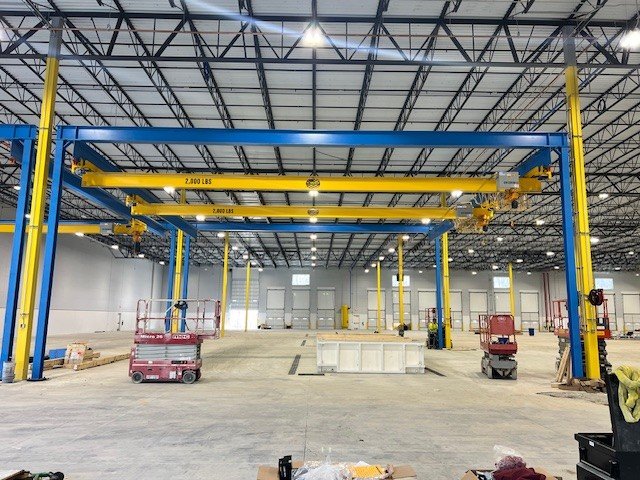
Two bridge cranes installed on each runway system
Each bridge designed for 2‑ton capacity
Additional 1‑ton labels supplied to support flexible operating configurations
Option to run two 1‑ton bridges
Or operate one 2‑ton bridge
50' bridge spans for wide area coverage
Approx. 20' under‑bridge clearance, suitable for larger components
Runways built with 1' stub sections
Simplifies future expansion
Supports continuous layout adjustments
Interchangeable system design
Bridges and runway sections can be moved, shared, or repositioned around the plant
Impact on the Facility
✔️ Highest level of flexibility
The customer can now adapt their crane capabilities to changing production demands without major rebuilds.
✔️ Smart capacity options
Dual labeling provides functional versatility from the same equipment.
✔️ Scalable for the future
Stub extensions allow the runway systems to grow as manufacturing needs increase.
✔️ Minimal disruption
System modifications can be made quickly, without lengthy downtime.
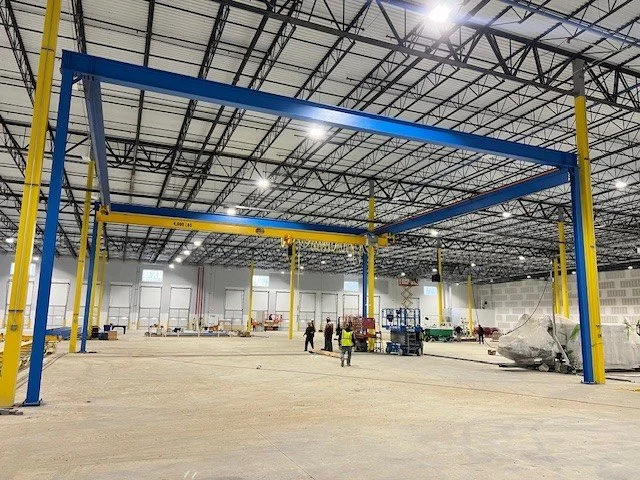
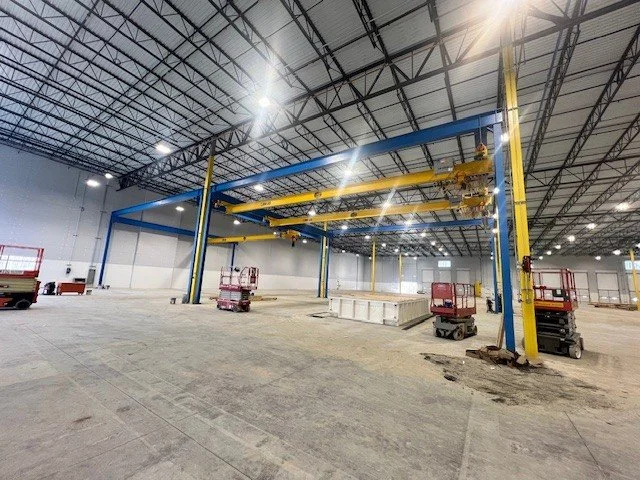
Outcome
The collaboration with Williamson & Wilmer resulted in a high‑performance workstation crane solution that supports the manufacturer’s current workflows while preparing them for future growth. The new free standing track systems give them a modern, flexible material‑handling infrastructure built for long‑term success.