
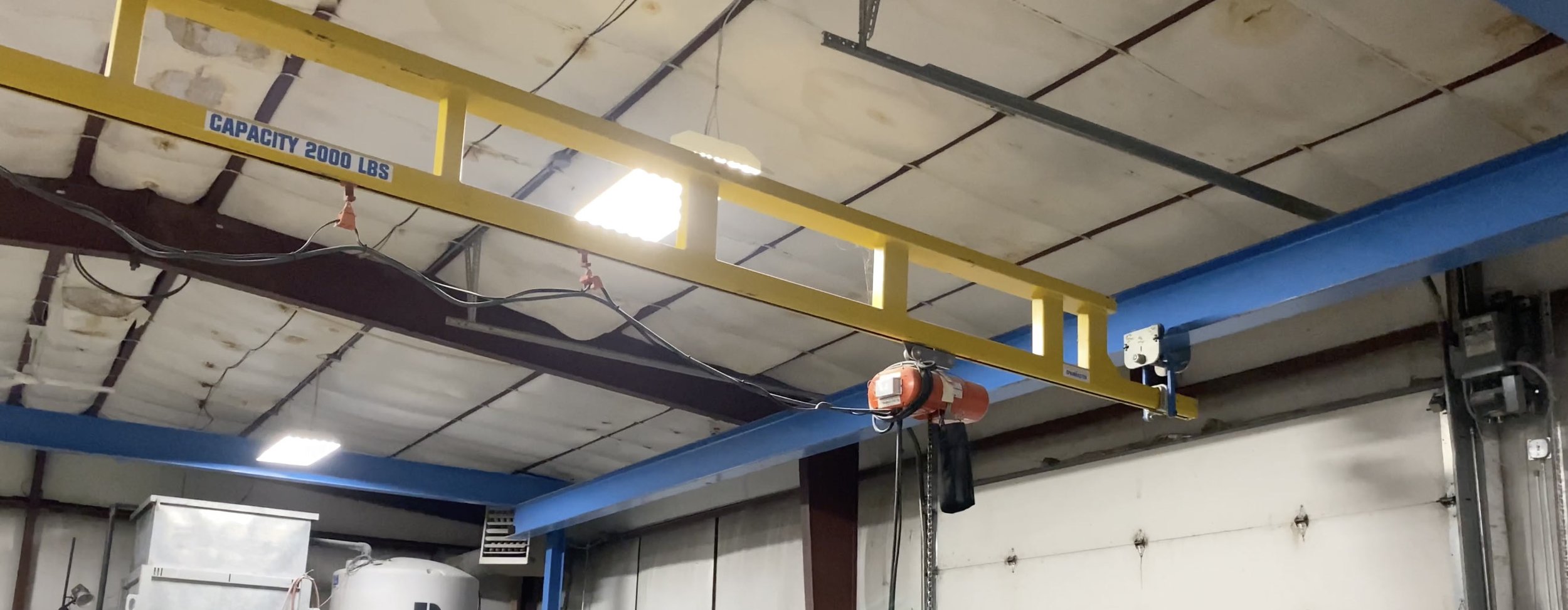
Two Designs, Different Strengths
Structural and enclosed‑track workstation cranes are designed for different demands. Here’s a quick side‑by‑side before we get into the details.
Spanmaster®
Spanmaster uses structural wide-flange runway beams paired with an enclosed-track bridge—combining the proven strength of overhead crane runways with the smooth, low-effort travel of enclosed track. It's built for facilities that require capacity, durability, and application flexibility without compromise.
- Up to 2 metric ton bridge capacity
- Up to 40' bridge spans
- Longer runway spans with fewer support columns
- Supports multiple cranes on a common runway—no buffer zones required
- Tolerant of runway misalignment and typical building movement when installed and maintained to spec
- Integrates with existing runway structures
- Low push force for repetitive, light-duty movement
- Articulating end truck design keeps end approach as low as 9" — unlike competitors' rigid end trucks, ours doesn't grow with bridge span
Enclosed-Track
Enclosed-track cranes use a boxed rail with internal bearing-equipped wheels. The enclosed design delivers low rolling resistance, making them effective for repetitive, light-duty lifting where minimizing operator effort is the primary objective.
- Low push force for repetitive, light-duty movement
- Best suited for clean, controlled environments
- Best fit for single-bridge, fixed-span applications
- Requires precise alignment to perform as designed
- Capacity considerations increase in multi-bridge applications
How They Compare
This table covers the factors that matter most when specifying a workstation crane. If you're short on time, the capacity row and the real-world tolerance row usually tell you which direction to go.
| Spanmaster® (wide-flange) | Enclosed-Track | |
|---|---|---|
| Capacity | Up to 2 metric ton bridge capacity—runway can be sized to support multiple bridges within a single bay without buffer zones | Up to ~2 tons for light- to medium-duty work—typically limited to a single 2-ton bridge per bay |
| Bridge Length | Up to 40' | Up to 34' (typical); up to 40' in custom designs |
| Runway Spans | Up to 50' (standard; repeatable system design) | Up to 30' (typical); larger spans require custom engineering |
| Push force | Low push force comparable to enclosed-track systems in real-world conditions | Low push force—optimized for light-duty, repetitive movement in controlled conditions |
| Tolerance to Real-World Conditions | High—maintains smooth operation under runway misalignment and typical building movement when installed and maintained to spec | Lower—sensitive to misalignment; requires tighter alignment and longer wheelbases to minimize binding at larger spans |
| Installation | Tolerant of building movement and minor structural variation—maintains consistent operation in field conditions | Requires precise alignment—installation accuracy directly impacts system performance |
| Cost | Competitive even on small, simple systems—advantage grows significantly as capacity, span, and system complexity increase, driven by fewer supports and scalable runway design | Lower initial cost for small, simple systems—cost increases as span, capacity, or system complexity grows |
What the specifications don't show
Specifications matter—but long-term performance is driven by how a system behaves under real operating conditions. These are the factors experienced engineers weigh most heavily.
Real-World Operator Behavior
Enclosed-track cranes deliver excellent ergonomics when properly used in controlled conditions. In practice, however, day-to-day operation can include abrupt stops and inconsistent handling, and enclosed-track systems have limited tolerance for that kind of variation — which can affect wheel performance and alignment over time.
Spanmaster's articulating end truck design is built to maintain consistent operation even where day-to-day handling isn't always perfect, reducing the sensitivity to variation that enclosed-track systems can have.
Building Compatibility
Enclosed-track systems typically require tighter structural tolerances — precise alignment, limited accommodation for building movement, and in many cases dedicated support steel matched closely to the rail.
Spanmaster's structural wide-flange runway integrates with existing runway steel and tolerates typical building movement and minor structural variation, and the knee-brace free-standing configuration provides rigidity without tying into the building at all — simplifying installation in facilities where structure isn't perfectly uniform.
Total Cost Over Time
Enclosed-track systems can have a lower initial cost in smaller, short-span applications, but ongoing costs — alignment checks, wheel/bearing wear from misuse, and constraints on system growth — tend to increase as the system ages or as demands on it grow.
Spanmaster's structural design and articulating end trucks reduce the maintenance sensitivity tied to alignment drift, and the ability to add bridges or adapt layouts within the existing runway — rather than re-engineering the structure — keeps long-term costs down as needs change.
Flexibility as You Grow
Spanmaster's runway uses non-proprietary structural beams, which can sometimes leave room to add bridges or capacity later using components already in place—though this depends on how the original system was sized and isn't guaranteed.
As layouts evolve, the system can often be adapted within the existing runway structure, which can reduce the need for significant structural changes.
Quick Selection Guide
Most applications point clearly to one system. Here's how TC/American's engineers typically advise.
Choose Spanmaster® When…
The workhorse for manufacturing, fabrication, and mixed-use facilities.
- Multiple bridges may be required within a single bay
- Longer bridge lengths are needed
- Longer runway support centers are required to reduce columns
- System capacity or utilization may increase over time
- Layout flexibility within the runway system is important
- Tight end approach matters — as low as 9" with our articulating end truck design
- Because the system uses non-proprietary structural beams, there's sometimes room to add bridges or capacity later using components already in place—though this isn't guaranteed and depends on how the original system was sized
Choose Enclosed-Track When…
The precision choice for controlled environments and light-duty ergonomic lifting.
- A rigid system with minimal visible movement is preferred over an articulated design
- Simple, single-bridge workstation applications are all that's needed
- Layout is fixed and no future expansion is planned
- A boxed-rail enclosed system is specifically preferred for the application
What Makes Spanmaster® Different
Spanmaster is built around structural runway design and articulated system behavior—not just component selection—allowing the system to accommodate alignment variation and maintain consistent performance in real applications.
Longer Spans, Fewer Columns
Spanmaster uses structural wide-flange runway beams to span longer distances between supports, reducing columns, lowering structural requirements, and improving layout flexibility.
Non-Proprietary Design
Spanmaster uses structural wide-flange runway beams and standard components, reducing reliance on proprietary parts and allowing more flexible sourcing and long-term serviceability. Because these are standard structural components rather than application-specific proprietary parts, there's sometimes room to add bridges or capacity later using components already in place—though this depends on how the original system was sized and isn't guaranteed.
Articulating End Trucks
Articulating end truck connections allow the system to accommodate alignment variation and maintain consistent bridge travel under real-world conditions. Because the end truck design doesn't grow with bridge span the way rigid designs do, end approach can be as low as 9"—reducing push force at the ends of travel, where loads and geometry typically increase resistance.
Multiple Bridges, No Buffers
Spanmaster's runway design supports multiple bridges on a common runway without intermediate buffer zones, increasing system capacity and utilization within a single bay.
Knee-Brace Free-Standing
Provides structural rigidity in a free-standing system without tying into the building, simplifying installation and reducing dependence on existing structure.
Flexible Mounting
Available in ceiling-supported or free-standing configurations, allowing the system to adapt to different building structures and installation constraints.
Not Sure? Let Us Help You Decide.
Every application is different. Your TC/American dealer, supported by our engineering team, will evaluate your requirements and recommend the workstation crane system — Spanmaster® or enclosed‑track—that fits your operation.
Get a Free Consultation